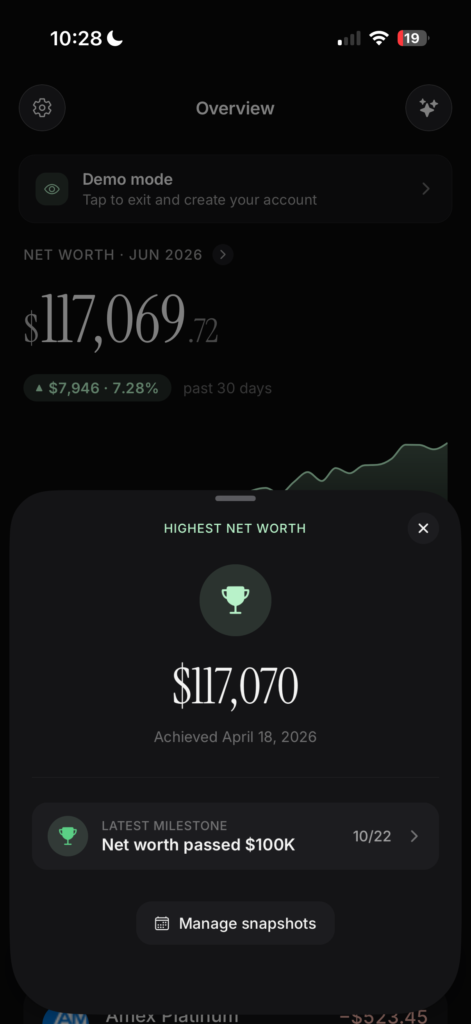
Category: Product Updates

  • A Retirement Planner, Allocation Targets, and a Fee Analyzer for Your Portfolio

    A Retirement Planner, Allocation Targets, and a Fee Analyzer for Your Portfolio

    Tracking your net worth answers “where am I.” This release is about the next two questions: “where is this going” and “is my portfolio actually set up to get there.” NetTrack 1.6.14 adds a retirement planner that solves for your financial independence date, an allocation view that turns a target mix into buy and sell amounts, and a fee analyzer that puts a dollar figure on what your funds charge. Here’s what’s new.

    Plan: your FI number and the year you reach it
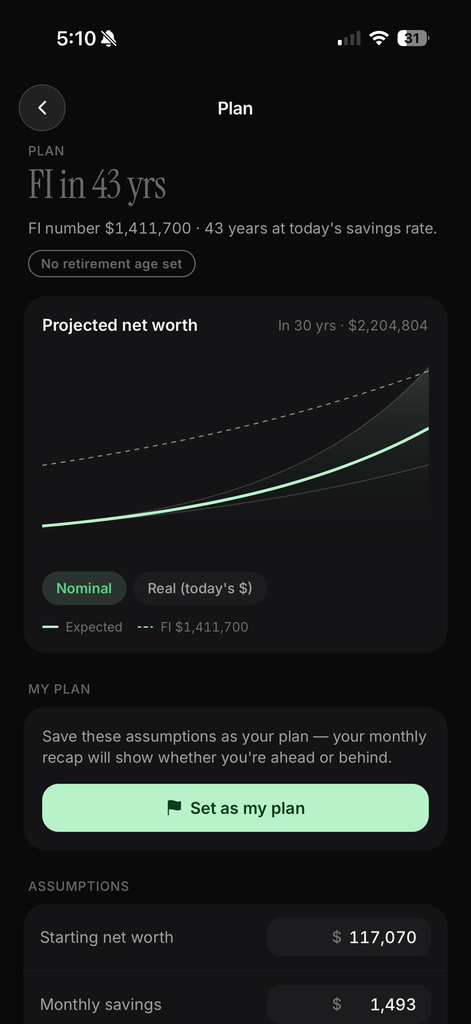
    The old Scenarios screen let you project your net worth forward. It’s now called Plan, and it answers a sharper question: when can you stop working?

    Enter what you’d spend in a year of retirement and Plan computes your FI number, the portfolio that funds that spending at your chosen withdrawal rate (4% by default). Then it runs your current net worth and monthly savings forward and tells you the year you cross it. The verdict sits at the top of the screen in plain language: “FI in 43 yrs,” “On track: FI at 58,” or “Short: FI at 63 at this pace.”

    The projection chart now draws the FI number as a dashed line, so you can see the gap close. Toggle between Nominal and Real (today’s $) to see the same path with inflation stripped out. A shaded band around the expected line shows the optimistic and pessimistic cases, two points of return either side of your assumption.

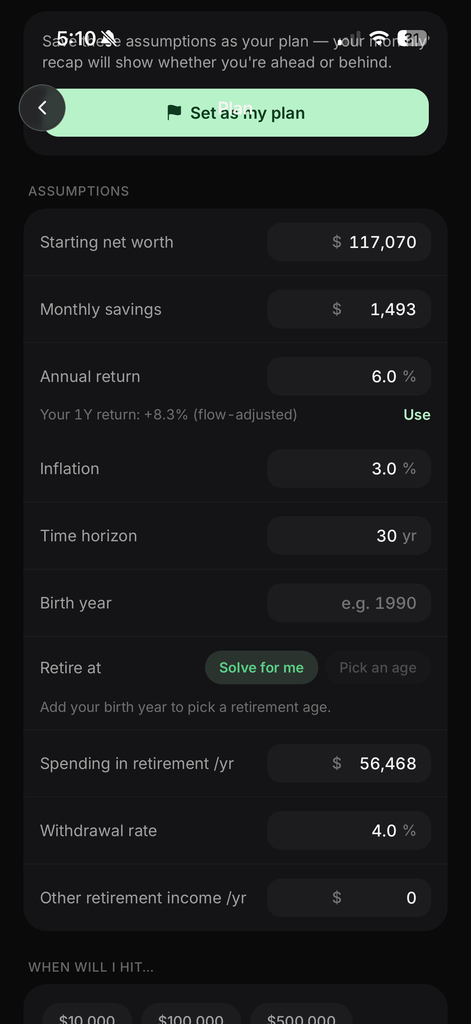
    Every input is editable, and the defaults come from your data rather than a textbook:

    • Starting net worth and monthly savings are pulled from your accounts and your actual savings rate.
    • Annual return shows your own flow-adjusted 1-year return next to the field, with a one-tap Use to plug it in.
    • Spending in retirement starts from what you spend today.
    • Other retirement income covers a pension, Social Security, or rental income, and reduces the portfolio you need.

    Pick an age, and Plan tells you what it takes

    Add your birth year and you can switch Retire at from “Solve for me” to a specific age. If your current pace gets you there, Plan says so and by how many years to spare. If it doesn’t, it solves the other direction: “Save $410 more a month to retire at 60.” That single number is the whole point of a planner, and most of them make you find it by trial and error.

    Past your retirement age the projection flips from contributing to withdrawing. Your chosen spending comes out each year, adjusted for inflation, and the chart keeps going so you can see whether the money lasts. If the pessimistic case runs out, the verdict tells you the age it happens.
    Set it as your plan

    Tap Set as my plan and the assumptions you’ve dialed in become your saved plan. From then on your monthly recap checks your real net worth against the plan’s expected path and reports “On plan,” “$2,300 ahead of plan,” or “$1,100 behind plan,” along with roughly how many months ahead or behind you’re running. The Plan tile on the Cash Flow tab shows the same verdict, computed the same way, so the two never disagree.

    Below the assumptions, When will I hit gives quick answers for $10,000, $100,000, $500,000, $1,000,000, or any target you type.

    Plan is a Premium feature.

    Allocation: from “what do I own” to “what should I move”
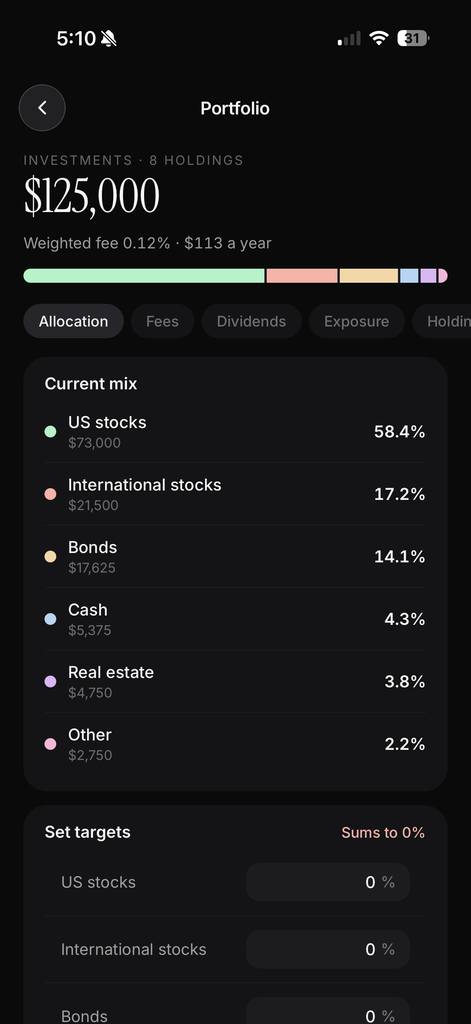
    The Portfolio screen’s Allocation tab now classifies every holding into six buckets: US stocks, international stocks, bonds, cash, real estate, and other. A single-stock position is easy. A fund is not, so NetTrack looks through it. A total-market ETF is counted as US stocks, a global fund is split between US and international by its actual country mix, and a balanced fund is divided between stocks and bonds by what it holds. Tap any class to see the holdings behind it and how much of each one landed there, so you can check the classification rather than trust it.

    Then set your targets. Enter the mix you want, and the tab switches from “Current mix” to Mix vs target, showing the drift for each class in percentage points and the amount to move: “Buy $4,200” of bonds, “Sell $1,900” of US stocks, or “On target” when you’re within two points. Targets are saved to your account, so the next time you open Portfolio the drift is already computed against them.

    Fees: what your funds actually cost
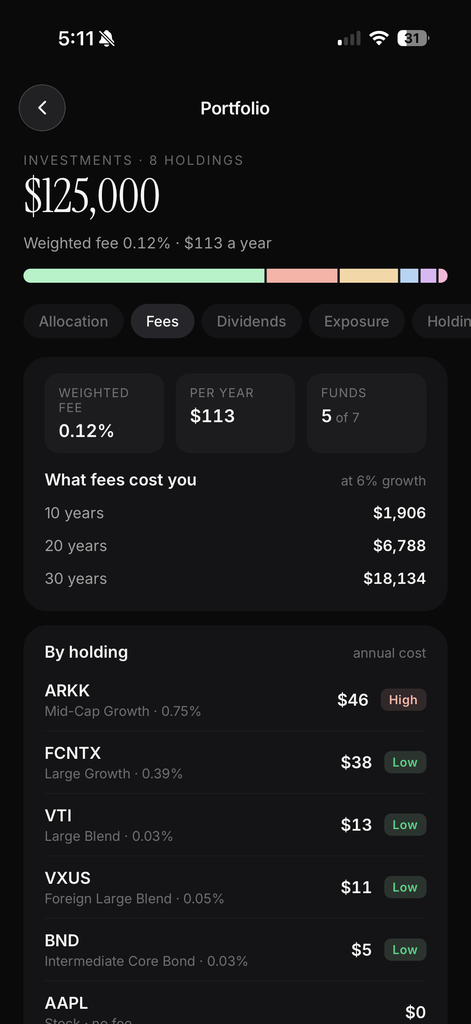
    The Fees tab turns expense ratios into money. At the top: your portfolio’s weighted fee, what that comes to per year, and how many of your holdings are funds with a published expense ratio. Below that, What fees cost you projects the drag over 10, 20, and 30 years at your assumed growth rate. A portfolio with a 0.12% weighted fee looks nearly free until you see it’s $18,000 over 30 years, and a 0.75% one is several times that.

    Every fund gets its own row with its Morningstar category, expense ratio, and annual cost in dollars, sorted by what it costs you. Anything over 0.5% is flagged High. Individual stocks show as no fee, so the list separates the funds worth a second look from everything else. The same fund held in two accounts is one row.

    The weighted fee and allocation bar also appear in the Portfolio header, so both are one glance away from the Investments tab.

    Also in this release

    • Dividends moved from the Investments tab to the Portfolio analytics screen, alongside Fees and Exposure, and the Investments row got a single Analytics entry point.
    • Exposure totals are now currency-converted, so the Allocation, Exposure, and Holdings tabs all agree on your total.
    • Savings rate history got the same 1M, 3M, YTD, 1Y, and All range pills as the Cash Flow tab.

    Available now

    NetTrack 1.6.14 is rolling out on the App Store and Google Play. Plan lives on the Cash Flow tab, and Allocation and Fees are on the Portfolio screen under Investments.

    If your plan says “short,” that’s the number we want you to see before it’s too late to do anything about it. Tell us what you’d change.
  • Face ID App Lock, New Net Worth History and Transfers

    Face ID App Lock, New Net Worth History and Transfers

    NetTrack shows the most private numbers you have, on a device you hand to other people all day. This release is about handling that responsibly, and about making the two things you do most with your history and your accounts a lot less fiddly. Here’s what’s new in NetTrack 1.6.13.

    App Lock

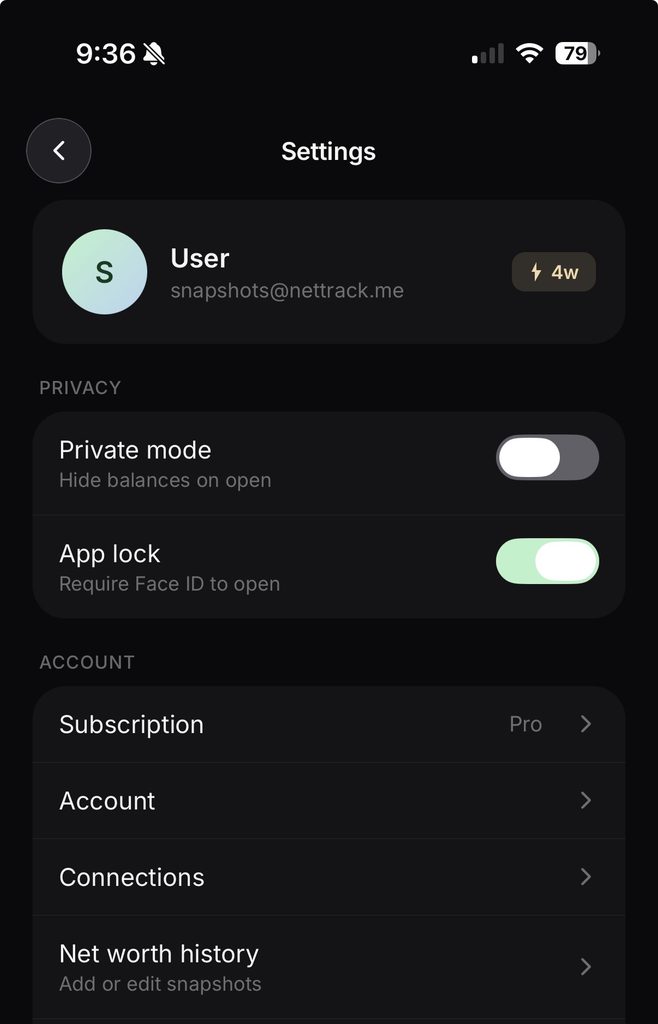
    Turn on App lock in Settings and NetTrack asks for Face ID, Touch ID, or your device’s biometrics every time you come back to it. Your phone’s passcode works as the fallback, so you’re never locked out of your own data.

    The part most apps get wrong is everything around the prompt. Swipe up into the app switcher and NetTrack’s card is blank instead of a readable screenshot of your net worth. Come back to the app and the lock is already up, with no flash of balances before the prompt appears. On Android, Recents shows the app icon rather than a thumbnail, and screenshots inside the app still work, because we’re hiding the preview, not fighting you.

    Net worth history, rebuilt around the chart

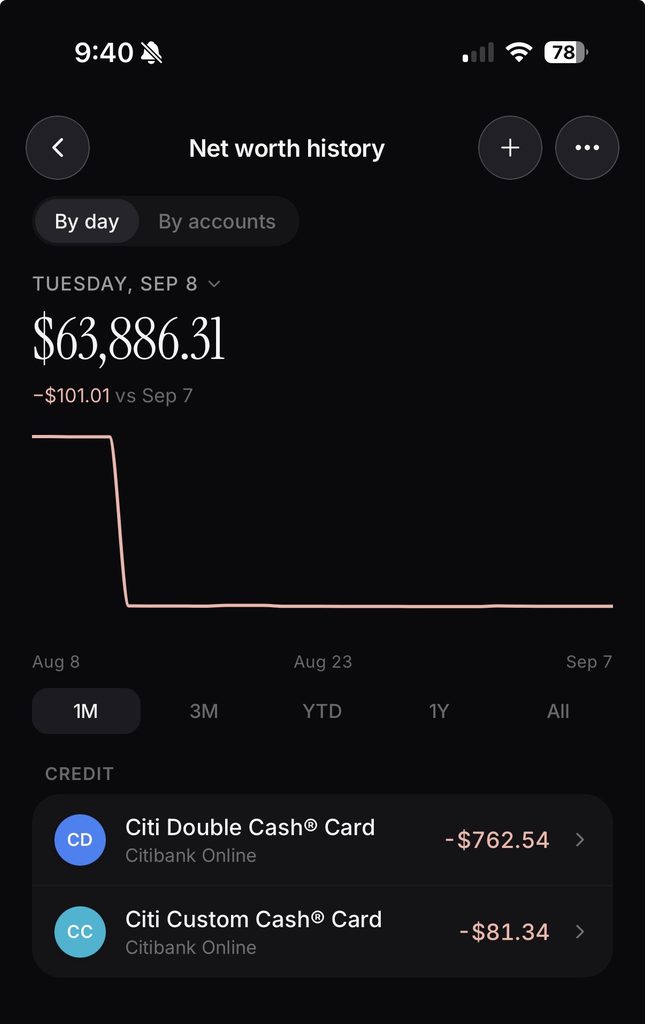
    Your history screen used to be a list you scrolled through. Now the chart is the way in. Drag along it and the day breakdown underneath follows your finger, with the same 1M, 3M, YTD, 1Y, and All ranges as the rest of the app. The big number at the top always reads what the chart reads, so what you see and what you scrub to never disagree.

    There are two ways to look at a day, and you pick the one that matches the question you’re asking:

    • By day shows every account’s balance on one date, grouped, so “what did I have on March 3rd” is one screen.
    • By accounts lets you pick one or several accounts and walk their balances forward through time, sectioned by month.

    Editing got the same treatment. Tap any row to correct a balance, swipe to delete a bad one, or pick a date range on the calendar to clear a stretch of history for the accounts you’ve selected. Every edit lands on the append-only history engine we shipped last release, so a correction is a new observation on the record, never an overwrite you can’t undo.

    Transfers between accounts

    Moving $2,000 from checking to savings is not spending $2,000, and it’s not earning $2,000 either. Until now, recording that move by hand meant two transactions that quietly distorted your cash flow in both directions.

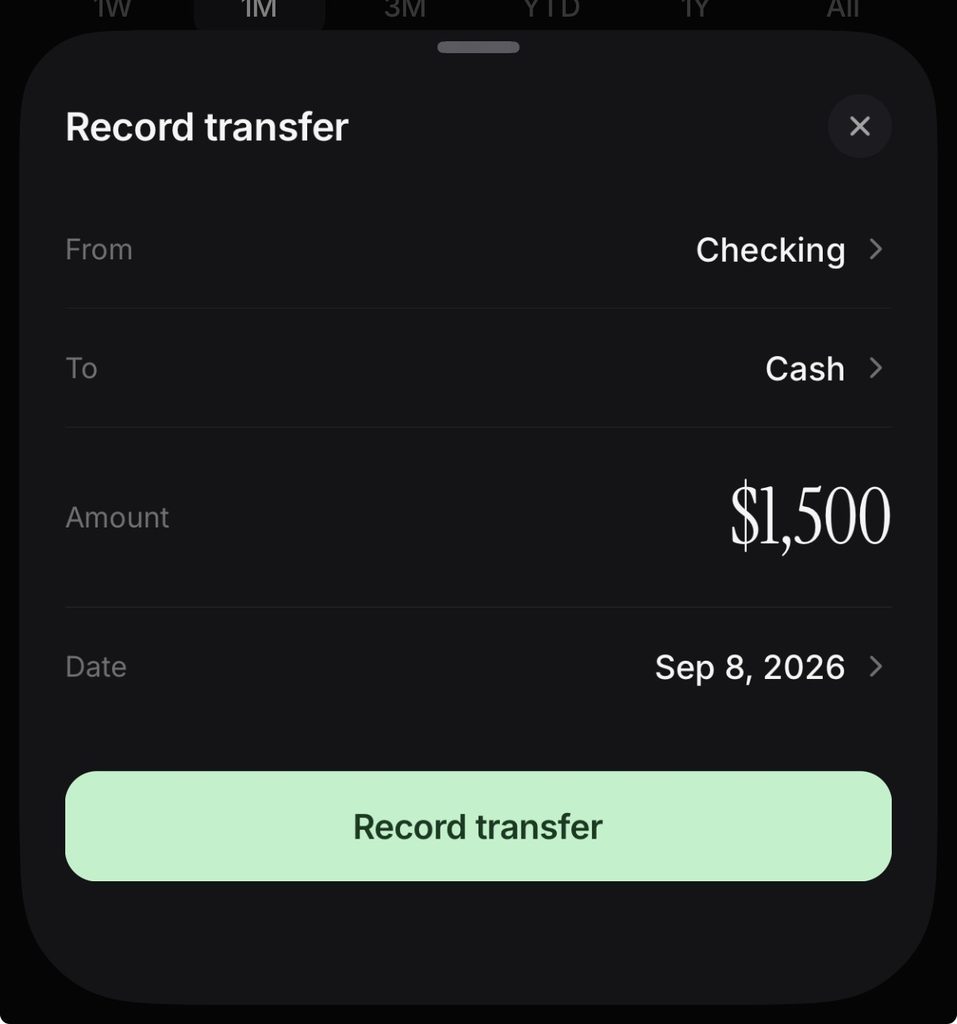
    Open an account’s menu and tap Record transfer. Pick where the money came from and where it went, add a note if you want, and NetTrack writes both sides at once. Both balances update immediately, and neither leg ever shows up as income or spending, so your cash flow, spending reports, and budget keep telling the truth.

    Available now

    NetTrack 1.6.13 is rolling out on the App Store and Google Play. App Lock is in Settings, the new history screen is under your net worth chart, and Record transfer is in every account’s menu.

    If there’s a piece of your financial life that still needs a workaround, tell us. Most of this release started as one.

  • Apple Wallet Comes to NetTrack: Apple Card, Apple Cash, and UK Bank Accounts

    Apple Wallet Comes to NetTrack: Apple Card, Apple Cash, and UK Bank Accounts

    NetTrack can now read accounts directly from Apple Wallet — Apple Card, Apple Cash, and Apple Savings in the US, and in the United Kingdom, the bank accounts you’ve connected to Wallet through open banking.

    For UK users especially, this is the big one: Barclays, HSBC, Lloyds, Monzo, Nationwide, NatWest, Santander and more, linked in a couple of taps, on the free plan. Here’s how it works, plus a round of investment tracking upgrades that shipped alongside it in NetTrack 1.6.10.

    Apple Card, Apple Cash, and Savings — connected directly

    Apple Card has never been linkable. Not in NetTrack, not in Monarch, not in Empower, not anywhere. It has no online banking portal for an aggregator to log into, so every net worth app in the world has had the same answer: add it as a manual account and update the balance yourself.

    That changes now. NetTrack reads Apple Card, Apple Cash, and Apple Savings directly from Wallet on your iPhone, using Apple’s FinanceKit framework — the pipe Apple built for exactly this purpose, and one that requires a per-app entitlement Apple reviews and grants individually. We applied, and we were approved.

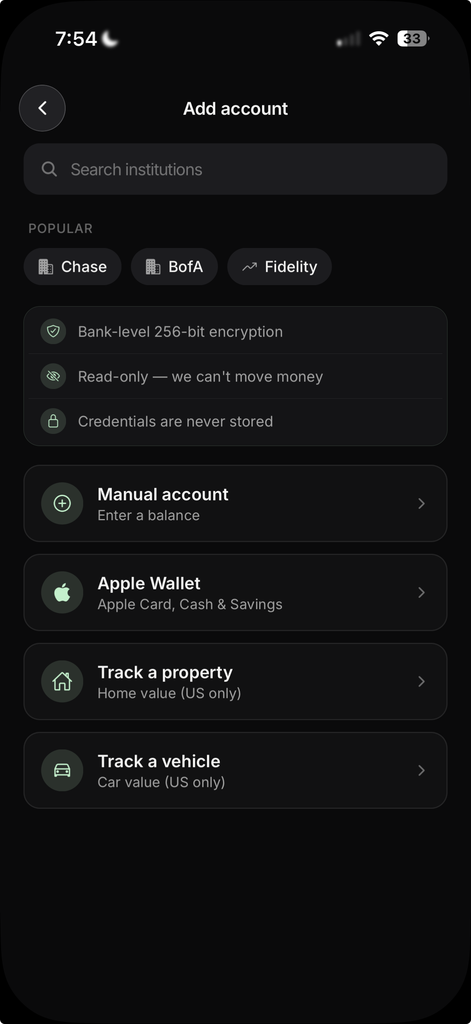
    Go to Add Account → Apple Wallet, and iOS shows you its own permission sheet: you pick which accounts to share, Apple hands them over, and NetTrack pulls in balances and transactions. From that point on your Apple Card sits alongside every other account — in your net worth, your snapshots, your cash flow, your budget, your spending reports. Not as a manual placeholder you have to remember to update. As a real, refreshing account.

    UK bank accounts, through the same door

    In the United Kingdom, Wallet does more than hold cards. On iOS 18.4 and later, it exposes open banking data for the UK bank accounts you’ve connected to it, through the same permission sheet. Apple currently makes thirteen institutions available to apps like ours: Barclays, Barclaycard, First Direct, Halifax, HSBC, Lloyds, M&S Bank, MBNA, Monzo, Nationwide, NatWest, Royal Bank of Scotland, and Santander.

    So if you’re a UK user who’s been maintaining manual accounts because US-centric aggregator coverage never quite reached you: connect your accounts in Wallet, tap Add Account → Apple Wallet in NetTrack, and they flow in with balances and transactions like any other linked account. They feed your net worth, your budget, your cash flow, and your reports the same way.

    Same screen, same free tier, same on-device privacy model as Apple Card. No credentials, no third-party aggregator, no waiting on coverage.

    What to know

    • It’s free. Apple Wallet accounts don’t count against the 5-connection limit on the free plan.
    • The data never round-trips through a middleman. FinanceKit is an on-device store. Your phone reads it and syncs it into your own NetTrack account — there’s no aggregator holding credentials, because there are no credentials to hold.
    • You choose the accounts, and you can change your mind. Sharing is managed in iOS Settings → Privacy & Security → Wallet, not by us.
    • Requires iOS 17.4 or later (iOS 18.4+ for UK open banking accounts), and at least one supported account in Wallet. Apple Card Family participants and Apple Cash Family child accounts aren’t exposed by Apple.

    Investment tracking upgrades

    The Portfolio screen got a rebuilt performance engine in the same release.

    Time-weighted returns. Your return is now computed the way brokerages compute theirs — a chained daily time-weighted return, measuring each day against the capital actually at work that day. Deposits and withdrawals move your balance, not your return, which means the figure in NetTrack lines up with the one on your broker’s statement. We checked ours against Fidelity’s per-account numbers and matched to within three hundredths of a percentage point.

    Contributions, shown alongside returns. A percentage on its own can’t tell you whether an account grew because it earned or because you funded it. Account rows now show contributions next to the return, and your monthly recap reports market gain and return as separate lines. Scrub the portfolio chart and the chip gives you a dollar figure and a percent on the same basis at every point.

    Available now

    All of it is live in NetTrack 1.6.10 on the App Store. Apple Wallet connections are free on every plan; investment tracking is part of NetTrack Pro.

    If you’ve got an Apple Card sitting in a manual account gathering dust — or you’re in the UK and have been waiting for a way in — this is the update to open.

  • Your Car Is Part of Your Net Worth Now

    Your Car Is Part of Your Net Worth Now

    For most people, a car is one of the biggest things they own — and one of the biggest blind spots in their net worth. You either leave it out entirely, or you type in a number once and let it quietly go stale while the car depreciates underneath it.

    NetTrack 1.6.4 fixes that. Add your car once, and its value stays current on its own.

    Add a vehicle in one step

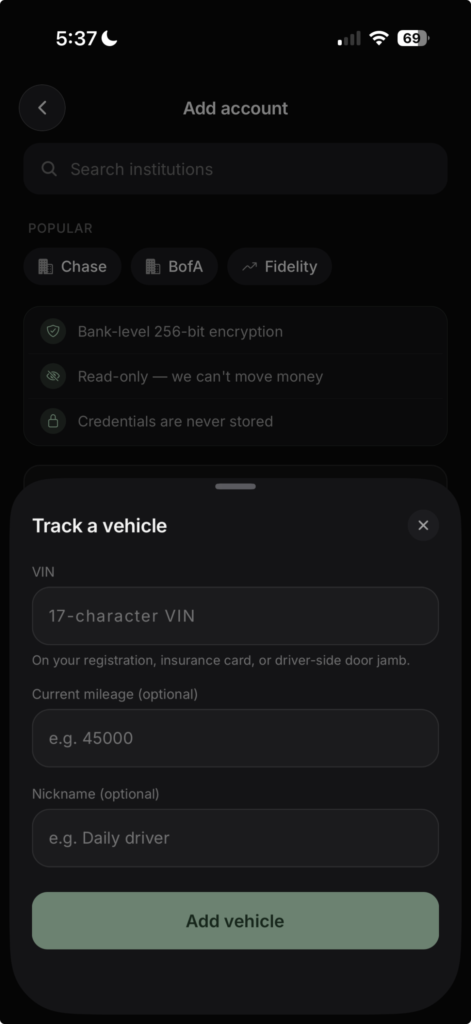
    On the Add account screen, tap Track a vehicle and enter your VIN — it’s on your registration, insurance card, or the driver-side door jamb. Current mileage and a nickname are optional, but mileage makes the estimate noticeably sharper.

    That’s it. No picking your trim from a dropdown, no guessing at condition tiers — the VIN identifies your exact year, make, model, and trim.

    A real market value, not a guess

    Your vehicle’s value comes from recent listings for cars like yours, adjusted for your mileage. You see the estimate, the range around it, and how it was built — how many listings, and how confident the estimate is.

    The value refreshes automatically every month, so depreciation shows up in your net worth as it happens — no manual updates, no stale numbers. A history chart tracks the value over time, with the same 1M / 3M / YTD / 1Y / All ranges as the rest of the app.

    A few details worth knowing:

    • Update your mileage anytime from the vehicle screen — the next refresh prices against it.
    • Disagree with the estimate? Set your own value. Your number is what counts toward your net worth, while the market estimate keeps updating alongside it so you can see the drift.
    • Your budget stays clean. Vehicle value changes are tracked in net worth, but they stay out of your budget’s Ready to Assign by default — depreciation isn’t money you can spend.

    Available now

    Vehicle tracking is live in NetTrack 1.6.4 on the App Store and on the web, included in NetTrack Pro.

    Got a boat, motorcycle, or something else without a VIN in our coverage? Tell us — we’re deciding what to value next.

  • Split Transactions, Notes, and Bulk Editing Are Here

    Split Transactions, Notes, and Bulk Editing Are Here

    One credit card charge is rarely one kind of spending. The $180 Costco run is groceries and household stuff and a new hoodie. The Amazon order is a gift, office supplies, and a phone case. Until now, NetTrack made you pick a single category and live with the distortion.

    This update fixes that — and makes cleaning up your transactions dramatically faster while we’re at it. Here’s what’s new in NetTrack 1.6.2.

    Split transactions

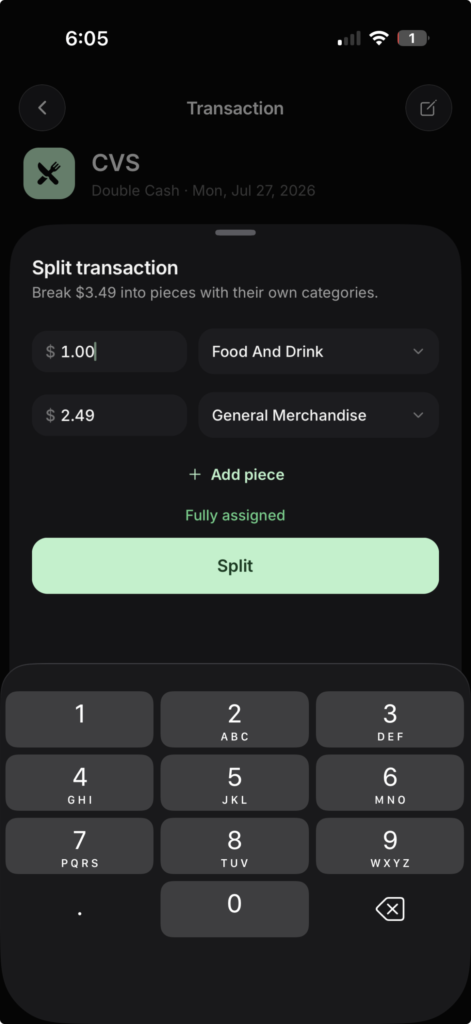
    You can now break any transaction into pieces, each with its own category and amount. Open a transaction, tap Split transaction, and divide it up — the pieces have to add up to the original, and a live counter shows what’s left to assign (with a one-tap “rest” shortcut for the last piece).

    Once split, the pieces behave like real transactions everywhere: your cash flow, spending reports, and budgets count what actually happened instead of one lump under “Shopping.” The original charge is never modified — it’s kept behind the scenes, and you can unsplit at any time to restore it exactly as it was.

    A few details we sweated so you don’t have to:

    • Day totals in your activity feed still add up to the penny — the pieces replace the original, never double-count it.
    • Your auto-categorization rules won’t fight your splits. A rule like “Costco → Groceries” leaves split pieces alone.
    • Recurring detection still sees the real charge, so splitting a subscription won’t break its history.

    Splits are part of NetTrack Pro, alongside Rules, Recurring, and Budgeting.

    Notes on transactions

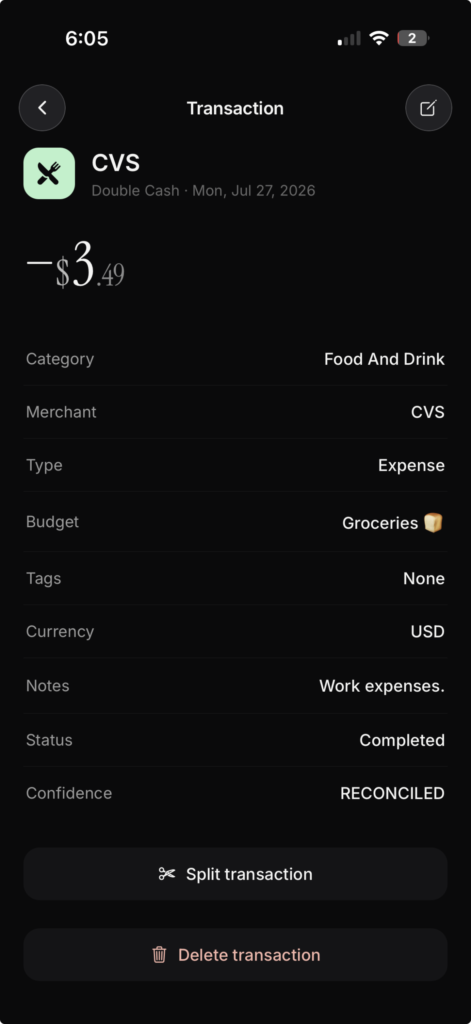
    Sometimes the transaction itself doesn’t tell the story. “Split with roommates — they Venmo’d me back.” “Tax deductible — home office.” “Warranty expires July 2028.”

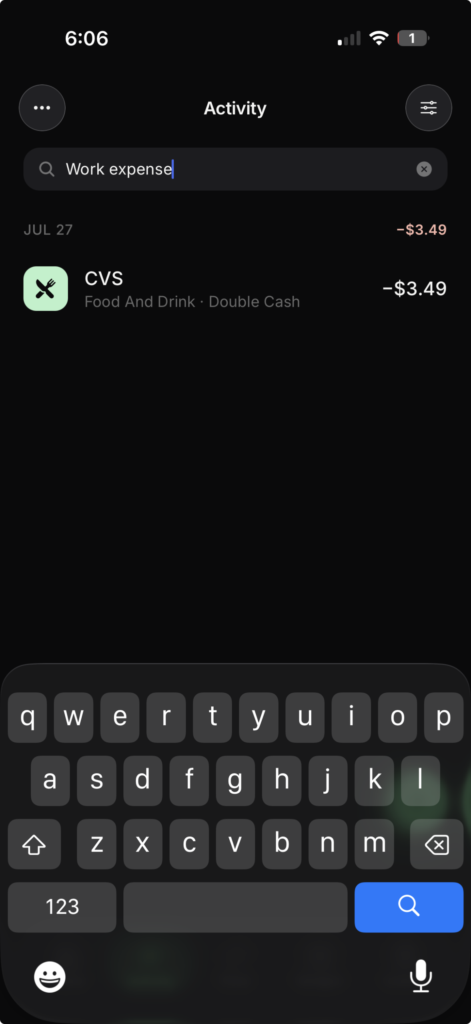
    Every transaction now has a notes field. Add context while it’s fresh, and find it again later — search in the Activity tab matches your notes, not just merchant names. Future-you will thank present-you at tax time.

    Multi-select and bulk editing

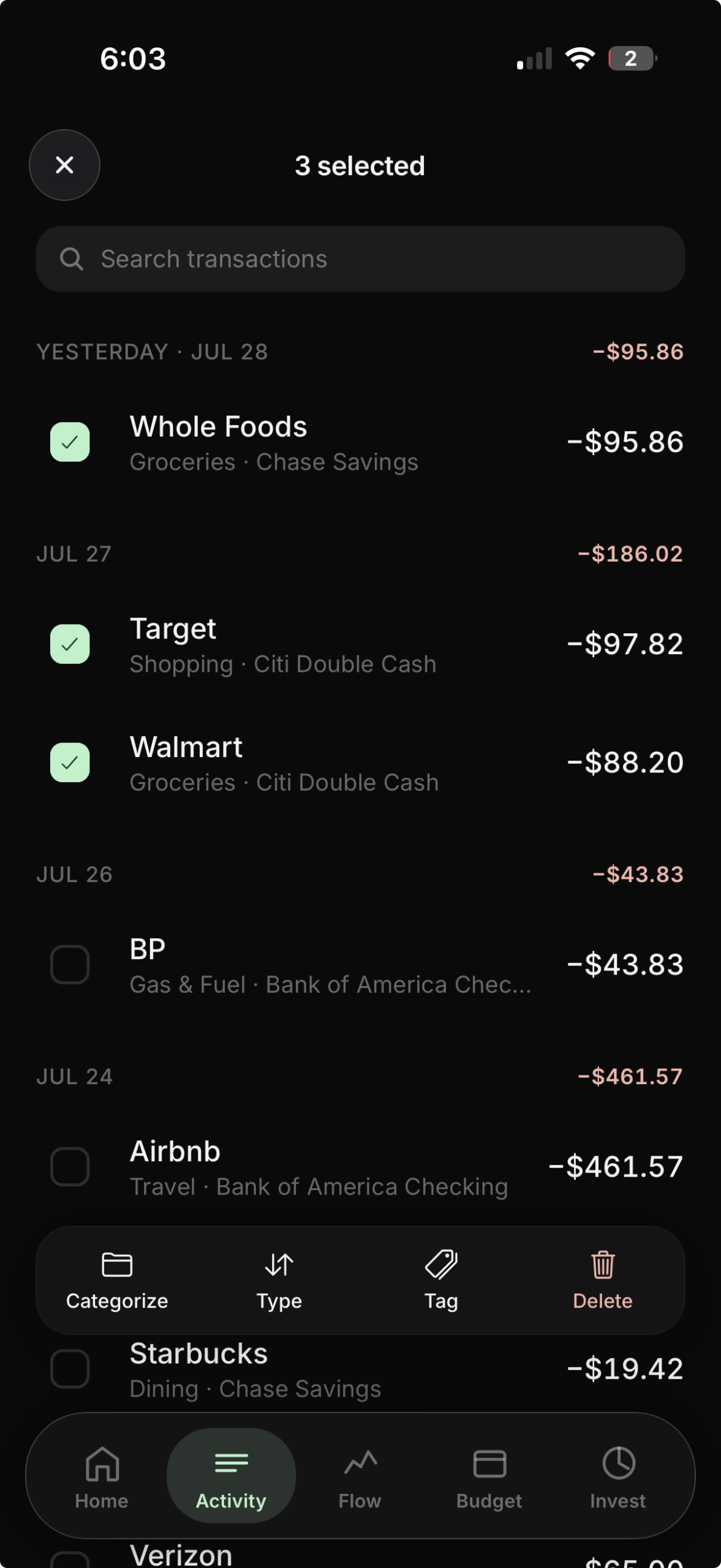
    Fixing transactions one at a time was the slowest part of keeping your data clean. Now: long-press any transaction in the Activity tab to enter selection mode, tap to select as many as you like, and apply one action to all of them — recategorize, set the type, add tags, or delete.

    NetTrack's Activity tab in selection mode with three transactions checked and a Categorize / Type / Tag / Delete action bar

    It composes with filters, too. Filter to a merchant or a date range, select everything that’s left, and fix a month of miscategorized transactions in about four taps.

    Available now

    All three features are live in NetTrack 1.6.2 on the App Store. Notes and multi-select are free for everyone; splits are included in NetTrack Pro.

    Got a messy merchant or a workflow that’s still slower than it should be? Tell us — most of this update came directly from user requests.

  • New in NetTrack: Milestones

    New in NetTrack: Milestones

    We just shipped a batch of updates that make NetTrack feel more rewarding to use — and give you a direct line to the people building it. Here’s what’s new.

    Milestones — every financial win, celebrated

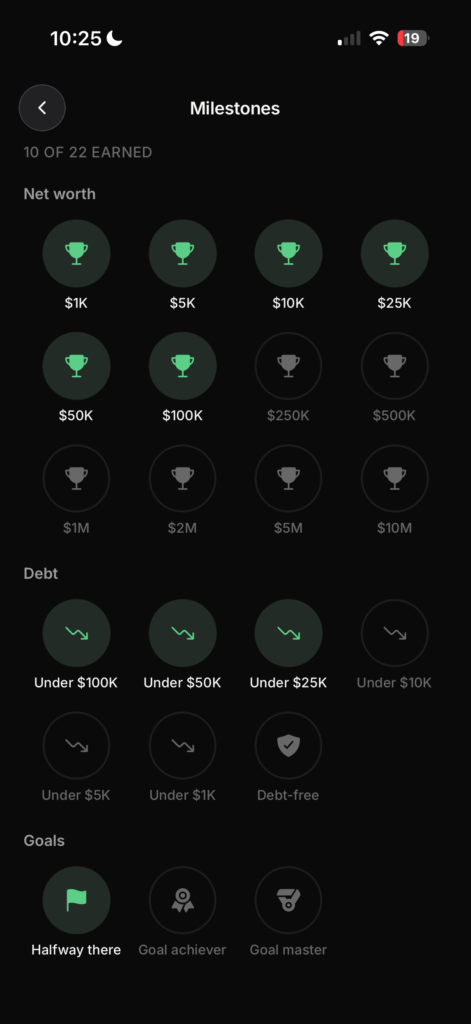
    Tracking net worth is motivating on its own, but the big moments deserve more than a number ticking up. Milestones automatically marks them and gives you a badge for each:

    • Net-worth records — every time you cross a new threshold
    • Debt paydown — milestones on the way down, all the way to debt-free
    • Savings goals — progress at 25%, 50%, 75%, and the moment you hit 100%

    When you cross one, NetTrack celebrates it — and the badge is yours to keep.

    You’ll find your badges right on the Home screen. Tap on your Net Worth to open the statistics sheet, and you’ll see the Milestones banner. Tap on it to open the full screen.

    Turn on milestone alerts in Settings → Notifications to get a heads-up the moment you hit one.

    Try it out

    Update to the latest version of NetTrack, then:

    1. Check your Home screen for new milestone badges.
    2. Head to Settings to message the team or browse Ideas.
    3. Drop us a feature request — we’re reading every one.

    Open NetTrack and see what you’ve earned.